среда, 13 марта 2019 г.

Sì, sei amabile con la depressione e L'ansia


Se ti preoccupi che la tua ansia o depressione limiterà le tue possibilità di relazioni, non sei solo. Molte persone sono preoccupate che avere una condizione psicologica—soprattutto cronica—possa renderli poco attraenti per le altre persone. Come faccio a trovare amici o un partner quando ho a che fare con la depressione o l'ansia? Chi vuole firmare per questo?

La paura del rifiuto può farti pensare che la tua unica opzione è quella di nascondere la tua condizione – che se dici la verità, la gente se ne andrà. Ma, la maggior parte delle persone non cerca la perfezione da te—vogliono l'onestà. L'onestà è il fondamento delle relazioni e della vera intimità. E piuttosto che le vostre lotte essere un rompiscatole, la persona probabilmente li riconoscerà come un unico aspetto di chi siete.

Ho sentito molti dei miei pazienti descrivere il loro sollievo per scoprire che i partner non sono stati rimandati quando hanno riconosciuto la loro condizione. I partner che hanno familiarità con l'ansia e la depressione possono capire la forza che serve per andare avanti. Potrebbero anche convivere con queste condizioni, visto quanto sono comuni.

E se non accettassero di te?e se, per loro, fosse un problema? E ' vero che non tutti avranno una risposta positiva alle condizioni di salute mentale. Ma se questo accade, o è già successo a te, ricorda che le scelte degli altri non ti definiscono. Se qualcuno non riesce a superare i tuoi problemi, questo dice molto di piu 'su chi e' che su di te. E solo perche ' quella persona in particolare non era a suo agio con le sue condizioni, non significa che tutti avranno la stessa risposta.

Tuttavia, quando qualcuno reagisce negativamente a te, fa male. Per molte persone, questo tipo di rifiuto può innescare pensieri automatici, Cenforce  come io sarò sempre solo, che possono sentire vero in questo momento, ma non si basano sulla realtà. Attenzione per i pensieri correlati che potrebbero comparire in questa zona, come:

    Essere ansiosa e depressa significa che non sono amabile.
    Non merito di essere felice.
    L'amore è per gli altri, non succederà mai per me.
    Sono troppo distrutto per essere amato.
    Nessuno mi vuole intorno.

E forse il pensiero più inquietante di tutti: non mancherei a nessuno se morissi. Questa convinzione è comune tra coloro che pensano di porre fine alla propria vita, ed è palesemente falsa. Non credeteci—più persone di quante vi rendiate conto di amarvi e apprezzarvi, e sarebbe divorato se metteste fine alla vostra vita. Le persone che tengono a te hanno bisogno di te, proprio come te. (Se si ha pensieri suicidi, si prega di contattare per aiuto: chiamare la linea di salvataggio Nazionale per la prevenzione del suicidio a 800-273-parlare o testo 741741 per connettersi con un consulente alla linea di testo crisi)

Come con qualsiasi pensiero problematico, Tadagra  iniziare riconoscendo loro come pensieri che possono o non possono essere veri. Allora condividili con qualcuno che tiene a te e che ti conosce bene. Saranno in grado di indicare dove sei troppo duro con te stesso. Se non l'hai già fatto, cerca anche il supporto di un professionista qualificato—qualcuno che può lavorare con te non solo sui sintomi che stai avendo, ma su qualsiasi dura auto-giudizio.

Passare attraverso l'ansia o la depressione o qualsiasi altra condizione psicologica non ti rende inamovibile—ti rende umano. E amiamo la persona che si fida di noi abbastanza da mostrarci la loro umanità. E 'probabile che ci siano persone che sono piu' disposte ad amarti di quanto tu possa immaginare. Perche ' non lasciarglielo fare?


6 domande da fare prima del sesso


Nonostante ciò che vediamo nei media, il sesso è un atto molto personale – con conseguenze sia fisiche che emotive. Quindi, e ' estremamente importante che tu la affronti con il pensiero serio che merita. Questo include fare a te stesso e al tuo partner alcune domande chiave.

3 domande da farti

Fare sesso corrisponde ai miei valori fondamentali? A un livello molto elementare, aiuta ad essere chiaro circa la portata dell'intimità emotiva e l'impegno che si crede che ci dovrebbe essere in una relazione prima di fare sesso.

C'è anche la questione se essere fisicamente intimi con una persona particolare si adatta alla vostra morale o ai vostri valori. Se tu o il tuo potenziale partner sessuale è in una relazione impegnata con qualcun altro, pausa prima di agire sui vostri desideri. Ci sono anche altre situazioni su cui vale la pena riflettere due volte, come andare a letto con il tuo capo. Quindi, qualunque sia la vostra circostanza, considerate i problemi che potreste creare agendo sulle vostre passioni.

Questa persona e ' una scelta saggia per me? Anche se siete incredibilmente attratti da qualcuno o hanno un aspetto fantastico sulla carta, potete sapere nel vostro cuore che non sono giusti per voi. Oppure, potresti avere qualche dubbio Fildena-100 assillante. Forse ti trattano male, sono insensibili agli altri (anche se ti idolatrano), lottano con un problema di rabbia o alcol, o sollevare preoccupazioni in qualche altro modo. In tutte queste situazioni, si potrebbe desiderare, almeno temporaneamente, di annullare la libido. Quando si fa sesso con qualcuno, si sta portando quella persona più nella vostra vita e cuore – una scelta che si può vivere a rimpiangere.

E ' il momento giusto? Il sesso può aumentare la vicinanza emotiva, quindi se non sei pronto ad avvicinarti, forse è meglio aspettare. Per esempio, Se sei appena uscito da una relazione a lungo termine, fare sesso troppo presto potrebbe interferire con lo sviluppo di quello che avrebbe potuto essere un buon partito. Allo stesso modo, agire sull'attrazione sessuale prima di conoscere qualcuno potrebbe sentirsi bene in questo momento, ma anche creare problemi nello sviluppo di una connessione più profonda.

3 domande da porre al vostro Partner

Cosa siamo l'uno per l'altra? Vuoi sapere se sei sulla stessa lunghezza d'onda, in modo da non farti venire il mal di cuore. Per chiarire la vostra situazione, potreste chiedere direttamente se sono single o romanticamente coinvolti con qualcun altro; e se sono alla ricerca di un'avventura o di una relazione impegnata.

Quando ha fatto l'ultimo test per le malattie veneree e L'HIV? Questa può essere una domanda scomoda da fare, ma è necessario essere sicuri di essere al sicuro da questi rischi potenzialmente gravi per la salute prima di andare avanti.

Cosa useremo per il controllo delle nascite? Qualsiasi cosa decidiate di usare, fate una scelta informata per prevenire una possibile gravidanza indesiderata o malattia.

Queste domande sono solo un inizio. Da lì si potrebbe desiderare di conoscersi meglio, approfondire la vostra intimità emotiva e sessuale. Ma queste domande fondamentali sono un punto di partenza essenziale per qualsiasi nuova relazione sessuale.

Disfunzione Erettile


Gli uomini con disfunzione erettile, una volta chiamato impotenza, hanno problemi a ottenere o sostenere un'erezione abbastanza a lungo per fare sesso. E ' una condizione comune, che colpisce ben 30 milioni di uomini americani. La disfunzione erettile colpisce gli uomini più anziani più degli uomini più giovani. Circa l ' 1% degli uomini sulla quarantina, il 17% degli Cenforce uomini sulla sessantina, e quasi il 50% degli uomini di 75 anni o più non sono in grado di raggiungere un'erezione sufficiente per il rapporto sessuale.

A volte la disfunzione erettile si sviluppa gradualmente. Una notte può richiedere più tempo o più stimolazione per ottenere un'erezione. Un'altra volta, un'erezione può non essere così ferma come al solito, o può finire prima dell'orgasmo. Quando tali difficoltà si verificano regolarmente, è il momento di parlare con un medico.

Il colpevole dietro la disfunzione erettile è spesso ostruito arterie. Infatti, in quasi un terzo degli uomini che vedono i loro medici circa problemi di ottenere o mantenere l'erezione, la disfunzione erettile è il primo indizio che hanno malattie cardiovascolari. Altre possibili cause di disfunzione erettile includono farmaci e Chirurgia della prostata, così come malattie e incidenti. Stress, problemi di relazione, o depressione può anche portare ad esso.

Indipendentemente dalla causa, la disfunzione erettile spesso può essere trattata efficacemente. Per alcuni uomini, semplicemente perdere peso può aiutare. Altri potrebbero aver bisogno di farmaci. Se questi passaggi non sono efficaci, sono disponibili diverse altre opzioni, tra cui iniezioni e dispositivi sottovuoto. Data la varietà di opzioni, la possibilità di trovare la soluzione giusta è ora più grande che mai.

Thriving with localized prostate cancer

There's a lot you can do to improve your outcome if you're taking an active surveillance approach to your diagnosis.


About 90% of men diagnosed with prostate cancer have the localized kind, which means the cancer is confined to the prostate gland. And for many, a reasonable approach is active surveillance, in which men choose to monitor their cancer instead of going straight into invasive treatments, such as surgery or radiation therapy.
Active surveillance includes a doctor visit about every six months, most often with a prostate-specific antigen (PSA) blood test and digital rectal exam.
A repeat prostate biopsy is usually done within the first year and may be repeated periodically in the future. If your test results change, your doctor would then talk with you about treatment options.
It might seem hard to accept what can feel like a passive wait-and-see approach when faced with such news as a cancer diagnosis. But that doesn't Fildena.
"For some men, a diagnosis like this can be used as a wake-up call to change their lifestyle, improve their health, and possibly keep their cancer from becoming more aggressive," says Dr. Marc Garnick, a urologic cancer expert at Harvard-affiliated Beth Israel Deaconess Medical Center.
So what can you do? Quitting smoking is the first step, says Dr. Garnick. After that — no surprise — it boils down to two areas: diet and exercise.

Diet: Go Mediterranean

There is no specific prostate cancer diet, and the jury is still out on whether specific dietary habits, like increasing your intake of omega-3 fatty acids, can influence prostate cancer growth.
"A better approach would be to examine your diet as a whole and make sure you adopt one that is low in red meat and sugar, which can increase inflammation. Instead, try to eat lots of whole fruits and vegetables, legumes, fatty fish, and grains," says Dr. Garnick.
The Mediterranean diet follows these guidelines and is highly touted for its heart-healthy benefits. Plus, an observational study published in the February 2018 issue of The Journal of Urology suggested that it also may be helpful for men with prostate cancer.
The researchers compared three types of eating patterns — Western, prudent, and Mediterranean — on almost 2,000 men, average age 66, who either had prostate cancer or were healthy.
The Western diet included large amounts of fatty dairy products, refined grains, processed meat, caloric beverages, sweets, fast food, and sauces. The prudent diet had low-fat dairy products, whole grains, fruits, vegetables, and juices. And the Mediterranean diet consisted of fatty fish (high in healthy omega-3 fatty acids), fruits, vegetables, legumes, and olive oil, and low consumption of juices.
After five years, the researchers found that men who strictly followed a Mediterranean diet had a much lower risk of aggressive prostate cancer, while men who ate the other two diets did not see the same benefit.
The Mediterranean diet could have multiple benefits for prostate cancer, according to the researchers. For instance, its core foods, like fruits and olive oil, can help lower inflammation, which may reduce the chances that cancer will grow or spread.

The weighty risk of prostate cancer

Overweight men have a greater chance of developing aggressive prostate cancer, and the cause may be higher insulin levels. Insulin has the potential to stimulate cancer growth. Being overweight causes resistance to insulin's ability to help move sugar (glucose) out of our blood and into cells, known as insulin resistance. Blood glucose levels rise and the pancreas needs to put out more insulin in response. "A healthy weight can have a domino effect too," says urologic cancer expert Dr. Marc Garnick. It also can keep blood pressure and cholesterol levels under control, and both high blood pressure and high cholesterol are linked with more aggressive prostate cancer.

Exercise: Intensity matters

Researchers have long suspected that physical activity — given its influence on a wide range of biological processes, including anti-inflammatory and insulin pathways — may be linked to a lower risk of prostate cancer. Now, a study published online Oct. 6, 2018, by European Urology found that vigorous activity may offer the greatest benefit.
Scientists from the Harvard T.H. Chan School of Public Health analyzed data, including medical records and pathology reports, from 49,160 men ages 40 to 75 who were followed for 26 years.
The men also responded to biennial questionnaires that included questions about diet, health, and physical activity. Among the participants, 6,411 developed prostate cancer and 888 had aggressive prostate cancer — cancer that spread or caused death during the study period.
The results showed that men who engaged most frequently in vigorous activity had a 25% lower risk of developing aggressive prostate cancer compared with men who exercised the least. And you don't need to do much, either. On average, Mazzogran in the highest category of vigorous activity did about 25 minutes of running per day. (Other activities that would be equal to this, depending on duration and intensity, include cycling, swimming, heavy outdoor work, and playing sports like tennis or racquetball.)
Why does the level of activity seem to matter? Besides helping with weight management, which can further reduce your risk (see "The weighty risk of prostate cancer"), it might affect prostate cancer on a cellular level. The study also explored the impact exercise had on a common molecular alteration in prostate tumors called TMPRSS2:ERG, a gene fusion that occurs in the tumors of about half of prostate cancer patients.

What exercises are best for bone health?


Q. Do men have to worry about bone health, and if so, what are the best exercises to keep my bones strong?

A. Most men have the advantage of continuing to produce bone-protecting testosterone throughout life. But the level of the male hormone declines with age and therefore may not be sufficient to keep bones strong as a man hits his later years.

Bones maintain their health throughout our lives in a continuous cycle of bone demolition and reconstruction. But as we age, the demolition process outpaces bone building. Eventually, men's bones can become thin, porous, weak, and susceptible to fractures. But the good news is that not every older man develops Fildena and, importantly, you can slow down the bone-destruction process with exercise.

Which type of exercise is best? Experts recommended weight-bearing activities that Fildena formation by putting pressure on your bones, especially in your hips and spine, which are common places for fall-related fractures. Examples of good weight-bearing exercises are walking, jogging, stair climbing, hiking, and even dancing.

Add in resistance training a few times per week, too, so you're stimulating bones in your wrists, arms, and lower body. Choose what kind of resistance training fits your life — free weights or resistance bands at home, or machines in the gym. Another type of exercise that can build stronger bones is "impact loading," like skipping rope. You could even combine it with your regular workout by jumping rope for a minute or two as part of your warm-up.

Men's Health

The leading cause of death for males in the United States is heart disease—followed closely by cancer. Adhering to a healthy lifestyle can help you avoid becoming part of the statistic. Here are some tips for a healthy life:

Your parents and grandparents, work and home habits, environment and lifestyle all contribute to your health and health risks. These factors may put you at an increased risk for certain diseases or conditions. Since you can’t change many of those factors, focus on addressing any negative behaviors you do have control over, such as your diet, activity level, or smoking. Make as many healthy changes as you can.

What you eat and drink can make a significant difference in your overall Cenforce . Eating five or more fruits and vegetables a day, increasing unsaturated fats and avoiding trans fats can improve health, reducing the risk of cancer and other chronic disease.

More than 60 percent of American men and women do not get enough physical activity to provide health benefits. For adults, 30 minutes of moderate physical activity on most days of the week is recommended. It does not take a lot of time or money, but it does take commitment. Start slowly, even five minutes a day, then work up to a satisfactory level, and don’t overdo it. Develop one routine or try something different every day. Find fun ways to stay in shape and feel good, such as gardening, swimming, walking or jogging.

Perhaps now more than ever before, job stress poses a threat to the health of workers and, in turn, to the health of organizations. Balancing obligations to your employer and your family can be challenging. Protect your mental health by engaging in activities that help you decrease your stress, both at work and home, such as engaging in your favorite hobby, exercising, reading, spending time with friends or doing something else you enjoy. Reducing stress can help keep you mentally healthy.

Routine exams and screenings can help save lives. Based on your age, health history, lifestyle and other important factors, you and your Fildena care provider can determine how often you need to be examined and screened for certain diseases and conditions. These include high blood pressure, high cholesterol, diabetes, sexually transmitted diseases and cancers of the skin, prostate and colon. When problems are found early, your chances for treatment and cure are significantly greater, so getting routine checkups could save your life.

The growing problem of an enlarged prostate gland

The most common prostate problem among men over age 50, this condition can cause embarrassing urination issues.

By age 60, half of all men will have an enlarged prostate, a condition also known as benign prostatic hyperplasia, or BPH. By age 85, the proportion reaches 90%.
While BPH does not increase your risk of getting prostate cancer or having sexual problems, it can affect quality of life, specifically by causing annoying and embarrassing urination problems.
"Since prostate enlargement happens gradually, men often think more frequent trips to the bathroom are a natural part of aging," says Dr. Howard LeWine, chief medical editor at Harvard Health Publishing and an assistant professor of medicine at Harvard-affiliated Brigham and Women's Hospital. "But a little medication can help relieve symptoms, meaning less urinary urgency and fewer nighttime awakenings to use the bathroom."

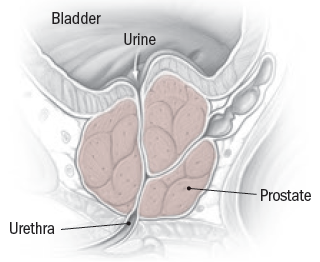
Benign prostatic hyperplasia


Illustration by Scott Leighton
An enlarged prostate places pressure on the urethra, which makes urine harder to expel.

Feeling the pressure

As you age, your prostate can grow from the size of a walnut to about the size of a lemon. It's not clear why the prostate grows like this, but it's believed certain male hormones such as dihydrotestosterone tend to act more strongly on the prostate gland later in life.
Because the prostate is located just below the bladder, when it becomes larger it can place pressure on the urethra, the tube that carries urine from the bladder through the penis and out of the body. This may lead to a variety of urination problems.
For example, you may have trouble beginning to urinate, continue to dribble afterward, and feel like you have not fully emptied your bladder. Urine that doesn't get expelled and collects in the bladder can increase the risk of infection, which in turn makes it painful to urinate and causes even more bathroom trips and potentially loss of bladder control. Urinary tract (or bladder) infections can also lead to a kidney infection.

Possible cancer protection from prostate drugs

Early research suggested that 5-alpha-reductase inhibitors (5-ARIs), a class of Cenforce used to treat prostate enlargement, might increase the risk of developing more aggressive prostate cancer. However, newer studies have found that not only do the drugs appear to pose no extra risk, they may even protect against prostate cancer.
For instance, research from the Prostate Cancer Prevention Trial study in 2013 showed that taking the 5-ARI finasteride (Proscar) for seven years could lower the chance of getting low-grade prostate cancer by 25% among men ages 55 and older. A follow-up study of almost 9,500 men, published in the Nov. 1, 2018, issue of the Journal of the National Cancer Institute, also showed that finasteride lowered the risk by a similar amount (21%), and found the protective effect lasted for at least 16 years.

Treating with drugs

See your doctor if you have any of these problems. A digital rectal exam can often confirm an enlarged prostate, and your doctor may take a urine sample to check for a bladder infection that can be treated with antibiotics.
If your prostate is causing symptoms, your doctor will likely offer you medication to improve and manage them. Two main classes of drugs are used: alpha blockers and 5-alpha-reductase inhibitors (5-ARIs). Your doctor may prescribe one or both types, depending on your symptoms and the size of your prostate gland.
Alpha blockers. These drugs relax the muscles around the prostate and the opening of the bladder, so urine can flow more easily. Common BPH symptoms often improve within two days. They are most effective for men with normal to moderately enlarged prostates. Commonly prescribed drugs in this class include alfuzosin (Uroxatral), doxazosin (Cardura), silodosin (Rapaflo), tamsulosin (Flomax), and terazosin (Hytrin).
5-ARIs. Drugs in this class slowly shrink the prostate so it stops pressing on the urethra. Treatment often reduces the prostate's size by one-quarter after six months to a year. The two common drugs are finasteride (Proscar) and dutasteride (Avodart).
Men might opt for surgery to remove excess tissue from the prostate if medications do not relieve symptoms sufficiently or cause undesirable side effects, or if there are complications like urinary retention or recurring urinary tract infections, adds Dr. LeWine.
For men who have both Vidalista 20 and symptoms of BPH, once-daily low-dose tadalafil (Cialis) is another option.